Robertson, Mitchell clash over 'dark money' in Alabama AG runoff
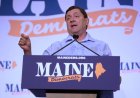
Robertson and Mitchell were among a group of GOP candidates to address the group at a seafood restaurant in Bayou La Batre. The two will face off Tuesday in a runoff that caps one of the most expensive attorney general races in state history.
 Mason Reed
The race for Alabama Attorney General has entered its final, high-stakes stretch, with former Alabama Supreme Court justice Jay Mitchell turning up the heat on his Republican runoff opponent, accusing Katherine Robertson of relying on heavy flows of dark money to fuel her campaign.
A Clash Over Campaign Finance
As voters prepare for Tuesday’s runoff, the candidates are embroiled in a heated debate over funding transparency. Mitchell maintains that much of the financial backing for Robertson, who serves as the chief counsel in the Alabama Attorney General’s Office, remains shrouded in mystery. He argues that the use of dark money—political spending by organizations that do not disclose their contributors—leaves Alabamians in the dark about who is actually influencing the race.
Robertson, however, defends her campaign's funding structure, pointing to support from established conservative organizations. She specifically highlights ties to the Republican Attorneys General Association (RAGA), which she credits as a vital partner in Alabama’s legal efforts in redistricting.
Redistricting and National Support
Speaking to the South Mobile Republican Women in Bayou La Batre, Robertson underscored the importance of these national relationships. She noted that RAGA played a pivotal role when 27 attorneys general united to support Alabama during its recent congressional redistricting litigation. That effort successfully culminated in a June 2 U.S. Supreme Court ruling that upheld a map favorable to Republicans.
"When we went to the Supreme Court in the redistricting case, those states swooped in to help us out," Robertson said. "Alabama is a small state … we have one of the smallest AG offices in the country. Those relationships are absolutely critical."
Despite her defense, financial reports indicate that more than half of Robertson’s campaign funds—roughly $2.7 million—originated from undisclosed sources. This includes approximately $1 million from RAGA-linked organizations, an additional $1 million from First Principle Action Inc., and over $1 million from Frontline Leaders Action Inc.
The Path to the Runoff
The Republican primary saw Robertson lead with 41% of the vote, while Mitchell secured 34% and Pamela Casey finished with 25%. With no candidate reaching the 50% threshold, Robertson and Mitchell were pushed to a runoff that has become one of the costliest in state history, with over $10.1 million spent between them. The victor will advance to the November 5 general election to face Democrat Jeff McLaughlin.
Mitchell, who boasts an endorsement from Casey, has made transparency a primary campaign pillar. He contends that 97% of his contributions are rooted in Alabama individuals and families. He has promised that, if elected, he will push for legislation mandating that nonprofits disclose their original donors to the Alabama Secretary of State.
This push for transparency follows recent discussions among state legislators regarding the influence of dark money in primary contests. Both House Speaker Nathaniel Ledbetter and Senate President Pro Tem Garlan Gudger have signaled interest in legislative reform, reflecting a growing appetite at the State House to curb these financial practices.
As the candidates hold their final events, the debate has continued to take center stage, keeping the spotlight squarely on campaign finance in the final hours before the polls open.